Your Complete Guide to Choosing a Dog Trainer in Detroit
Life with a dog in Detroit is vibrant. You might be walking along the bustling Riverwalk, exploring the Dequindre Cut, or enjoying a quiet moment in one of the city’s historic neighborhoods like Midtown, Corktown, or Indian Village. A well-trained dog can confidently join you for these adventures, navigating crowded patios in Eastern Market and staying calm amidst the energy of city life.
Wayne County, where Detroit is located, has specific rules that affect dog ownership. Understanding these local considerations is a key part of successful training. Finding a professional dog trainer who knows how to work within these urban dynamics can make all the difference for you and your dog.
How to Choose the Right Trainer
Start your search by looking for a trainer who uses humane, science-based methods like *positive reinforcement* training. This approach is especially important in a dense urban environment where building your dog’s confidence and trust leads to reliable behavior on busy sidewalks and in shared apartment building hallways.
Credentials offer a reliable way to gauge a trainer’s education and commitment. Look for professionals with certifications such as CPDT-KA or KPA-CTP. For serious behavior issues like aggression or severe anxiety, seek out a certified behavior consultant with credentials like IAABC-CDBC or CBCC-KA.
Consider your daily routine. In-home dog training is excellent for addressing problems specific to your living space, like door-dashing or reactivity in shared building elevators. Group classes are a great next step to proof basic obedience skills around other dogs and people before heading to busier public spots.
Common Dog Training Methods Explained
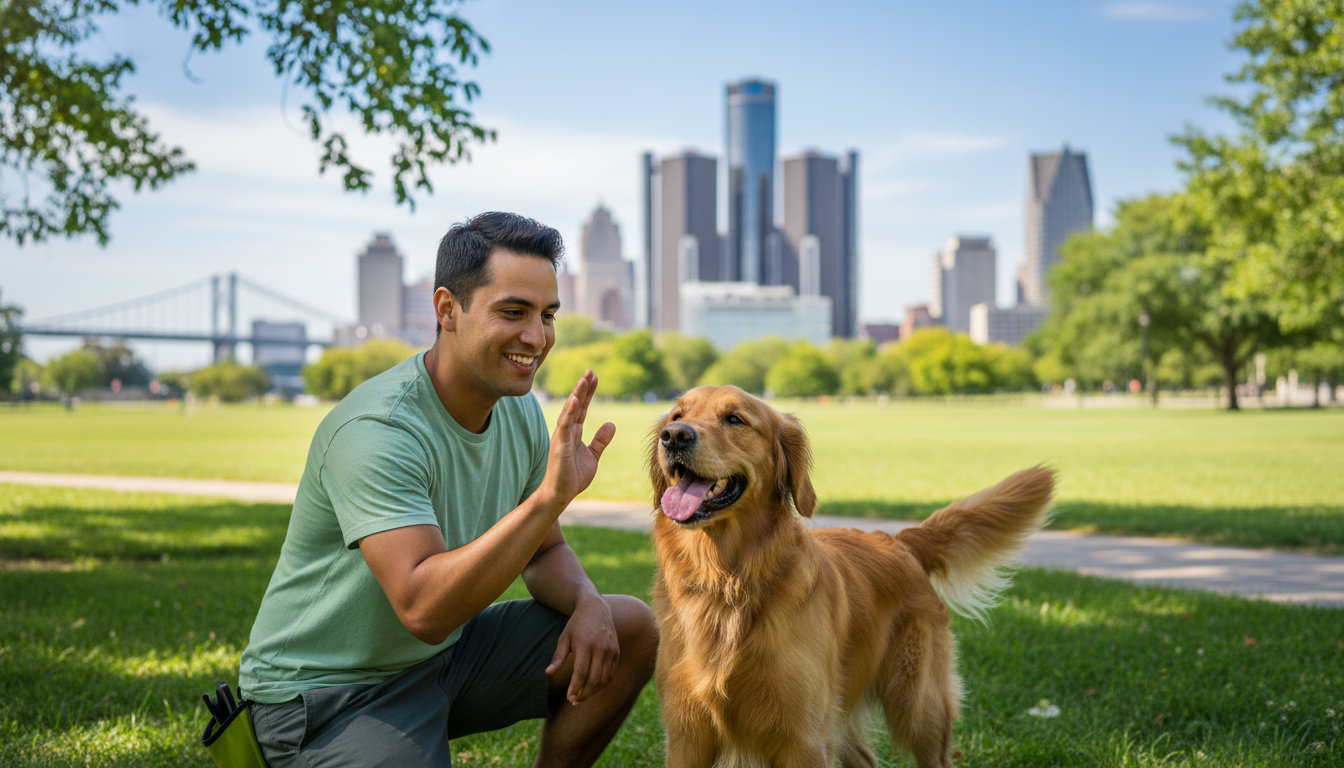
Reward-based training methods help create a happy, cooperative dog who can handle the unique stimuli of city living. This foundation supports compliance with local leash laws and helps maintain good relationships with neighbors in close quarters.
Basic obedience training**** covers essential cues like sit, down, stay, and a reliable recall. These skills are non-negotiable for safety on Detroit’s streets and in its parks.
Puppy training focuses on critical early life skills: socialization to city sounds, potty training in an apartment, bite inhibition, and crate training. Starting early prevents small issues from becoming big problems.
Behavior modification addresses issues like leash reactivity, fear of loud noises, or separation anxiety through structured, gradual programs. For complex cases, a top dog trainer will often collaborate with your veterinarian.
Private lessons offer fully customized attention, while group classes provide controlled environments to practice skills around distractions. Day training or board and train programs can be options for busy schedules, but require careful vetting of the facility and methods.
It is important to avoid trainers who use intimidation, fear, or pain to suppress behavior. These outdated methods can worsen fear and aggression, creating more danger in public settings.
Average Cost of Dog Training in Detroit, MI (Updated for 2026)
The cost of dog training services in Detroit and surrounding Wayne County areas varies based on the trainer’s expertise, service type, and program length. The following table reflects current local averages for 2026.
| Service Type | Average Cost (Detroit/Wayne County) |
|---|---|
| Puppy Class (6-week session) | $175 – $300 |
| Group Obedience Class (6-week session) | $200 – $350 |
| Private Lesson (60 min) | $90 – $150 |
| In-Home Training Package (4-6 sessions) | $400 – $850 |
| Day Training (per week) | $500 – $1,000 |
| Behavior Consultation | $175 – $300 |
| Board and Train (2-3 weeks) | $2,200 – $5,000 |
Prices for in-home sessions may include a travel fee depending on your location within the metro area. Always clarify what is included in a package and ask about policies for follow-up support.
Questions to Ask a Potential Dog Trainer
- What is your primary training philosophy, and can you explain how you use positive reinforcement?
- What professional dog trainer certifications do you hold, and how do you pursue continuing education?
- How will you tailor a training program for my dog’s needs and my Detroit lifestyle (e.g., apartment living, busy sidewalks)?
- Do you offer a free consultation or evaluation to assess my dog and discuss goals?
- What does your process look like for addressing specific issues like reactivity on the Riverwalk or separation anxiety in an apartment?
- Are you insured, and can you provide proof of liability insurance?
- Will you collaborate with my veterinarian if my dog has behavioral issues that may have a medical component?
- What is your preferred method for teaching owners how to maintain and build upon their dog’s new skills?
Local Detroit Rules and Considerations
Detroit and Wayne County have ordinances in place to ensure public safety and animal welfare. A good training program will help you and your dog comply effortlessly.
Dogs must be on a leash no longer than six feet when in public areas, unless in a designated off-leash zone. This is strictly enforced on city streets, parks, and greenways.
Michigan state law requires all dogs to be vaccinated against rabies. You must keep proof of this vaccination, and the rabies tag should be on your dog’s collar. Wayne County also strongly recommends and often requires distemper and parvovirus vaccinations.
Excessive, persistent barking that disturbs neighbors can lead to nuisance complaints. Training that addresses alert barking and separation anxiety is valuable for maintaining neighborhood harmony.
The State of Michigan does not require a specific license to operate as a dog trainer. However, trainers should carry liability insurance. If a trainer offers board and train services, their facility must be licensed as a kennel by the Michigan Department of Agriculture and Rural Development.
Local Detroit Resources for Dog Owners
These locations provide excellent environments to practice your dog’s skills in real-world settings. Always observe posted rules and practice good etiquette.
- Belle Isle Park: Leashed dogs are welcome on the island. The large, open spaces and paved paths are perfect for practicing long-distance stays and focused leash walking with distractions.
- Cass Dog Park (Midtown): A fenced, off-leash area ideal for practicing recalls and supervised socialization during off-peak hours.
- The Detroit Riverwalk: A prime location for advanced leash training, teaching your dog to ignore cyclists, joggers, and the sights and sounds of the river.
- Wayne County Parks (like Hines Park): Many county parks permit leashed dogs on trails, offering more natural settings for building focus and engagement.
- Detroit Dog Rescue: While not a training organization, this local group is a valuable community resource for adoption, low-cost veterinary services, and general animal welfare support.

FAQs
How much does in-home dog training cost?
In the Detroit area, a single in-home session typically costs between $90 and $150. Most trainers offer discounted packages of 4 to 6 sessions, which range from $400 to $850 total.
Is in-home dog training worth it?
For many Detroit residents, it is highly valuable. An in-home session addresses behaviors exactly where they happen—jumping on guests, barking at hallway noises, or reactivity from your front window. The trainer can then immediately transition to practicing leash skills on your specific block.
Can you pay someone to house train your dog?
Yes. Many trainers offer puppy packages that include a structured potty training plan. Some day training programs can also accelerate the process by implementing a consistent schedule during the day while teaching you how to maintain it.
What is the 3-3-3 rule for dog training?
This is a general guideline for a newly adopted dog’s adjustment period. It suggests 3 days to decompress, 3 weeks to learn your routine, and 3 months to feel fully at home. Effective training plans respect this timeline and build trust gradually.
How long will it take to reach my training goals?
For basic obedience and manners, consistent practice over 6-8 weeks typically yields solid results. More complex behavior modification for reactivity or fear can be a months-long process requiring patience and a structured training program.
What should I bring to group classes?
Bring a well-fitting harness or flat collar, a 6-foot leash (no retractables), high-value treats, and your dog’s vaccination records if required by the training facility. Bring your patience and a willingness to learn.
What’s the leash law in Detroit?
Detroit’s ordinance requires dogs to be on a leash no longer than six feet and under the owner’s control in all public areas, unless in a signed, designated off-leash dog park.
Do I need a dog license in Detroit or Wayne County?
The City of Detroit does not issue a general pet license. However, Michigan state law and Wayne County require a valid rabies vaccination and tag, which serves as your dog’s primary form of legal identification.
What shots does my dog need in Wayne County or Michigan?
Rabies vaccination is legally required. Most veterinarians will also insist on core vaccines for distemper, parvovirus, and adenovirus. Bordetella (kennel cough) is often recommended for dogs that will be in group classes or boarding.
Are dog trainers required to be licensed in Detroit or Wayne County or Michigan?
Michigan does not have a state-level licensing requirement for dog trainers. They operate under standard business regulations. However, as noted, any facility boarding dogs commercially must have a kennel license from the state.
Where can I practice off-leash recall?
The safest places are fully fenced dog parks like Cass Dog Park. Practice during less busy times to minimize distractions while you build a reliable recall in a controlled, legal environment.
Which dog parks allow training around Detroit?
Cass Dog Park in Midtown and other fenced public dog parks in surrounding suburbs are suitable for training during off-peak hours. Always ensure your dog is under voice control and be mindful of other park users.
What beaches or trails allow dogs for training?
While Detroit doesn’t have a beach, leashed dogs are welcome on the trails at Belle Isle Park and throughout many Wayne County parks like Lower Huron Metropark. These are excellent for practicing calm behavior around wildlife, water, and other trail users.
Are there breed-specific laws I should know about?
The State of Michigan prohibits municipalities from enacting breed-specific legislation (BSL). No cities or counties in Michigan can ban or place special restrictions on dogs based solely on breed.
Finding the right trainer who understands how to help your dog thrive in Detroit’s unique urban environment is an investment in a safer, happier life together. A focus on positive, relationship-based methods will help your dog become a confident and well-behaved companion for all that city living has to offer.