Your Complete Guide to Choosing a Dog Trainer in Live Oak and Surrounding Areas
Life with a dog in Live Oak means enjoying quiet neighborhood walks, trips to the Suwannee River, and community events at the Spirit of the Suwannee Music Park. A well-trained dog makes these local experiences enjoyable for everyone, from polite greetings at the IGA to calm behavior on a trail.
Live Oak is the county seat of Suwannee County, so local rules are typically set at the county level. Finding a professional dog trainer who understands this rural community’s specific needs can help your dog thrive in your home and around town.
How to Choose the Right Trainer
Look for a trainer whose methods are based on positive reinforcement and who can set realistic goals for your Suwannee County lifestyle. This means your dog should learn to walk nicely on a leash downtown, be calm around farm animals or tractors, and have reliable manners for visiting local parks.
Credentials offer a clear way to gauge a trainer’s expertise. Common dog trainer certifications include the CPDT-KA for general knowledge or the IAABC-CDBC for complex behavior issues. For serious cases like aggression, a certification like CBCC-KA is a strong indicator of specialized skill.
In-home training sessions are excellent for addressing behaviors in your specific environment, like barking at delivery trucks on your quiet street or jumping on guests. Group classes provide a controlled setting to practice around other dogs, which is good preparation for the Suwannee County Fairgrounds or other busy local spots.
Common Dog Training Methods Explained
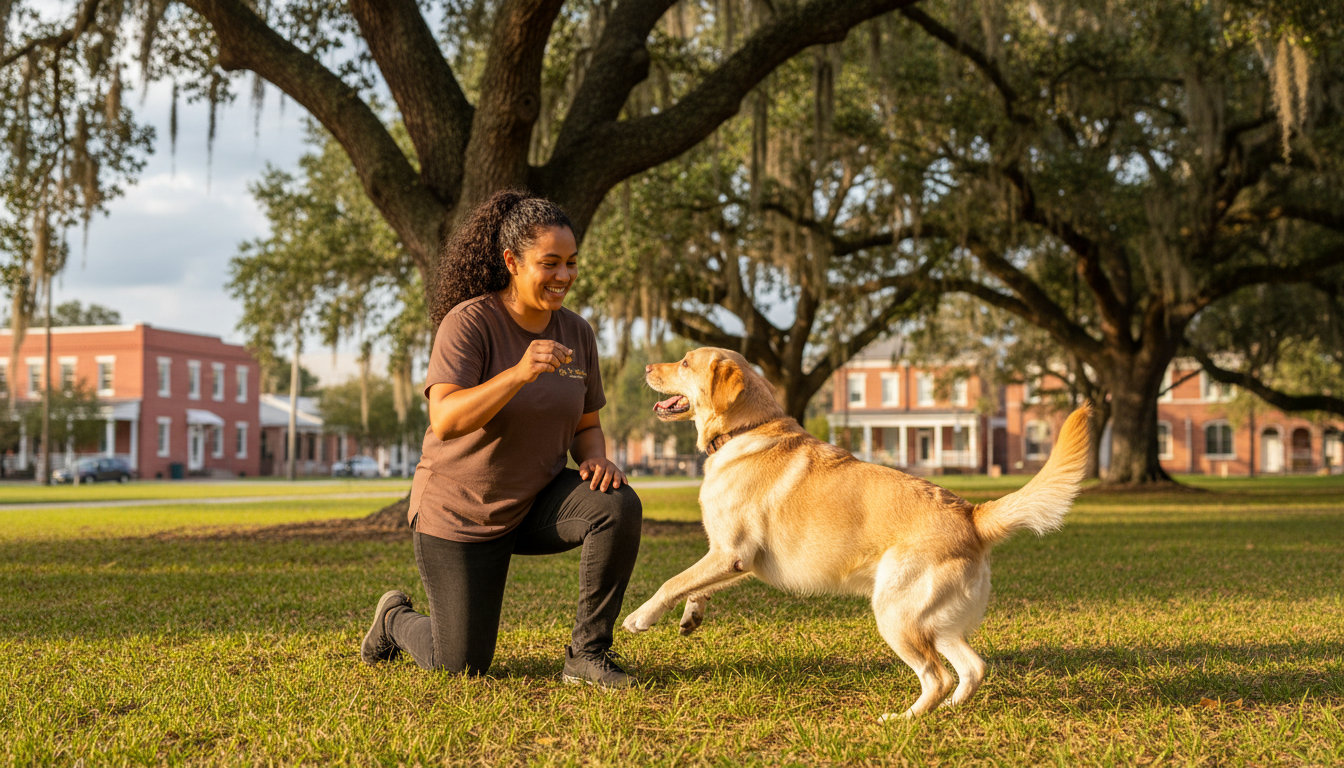
Modern, reward-based training builds a trusting relationship and creates lasting behavioral change. This approach also helps you comply with local ordinances about animal control and public safety.
Basic obedience training**** covers sit, down, stay, come, and loose-leash walking. These skills are the foundation for a well-behaved dog at the Suwannee River Greenway or while waiting outside a local shop.
Puppy training focuses on early socialization, potty training, bite inhibition, and crate training. Starting early prevents unwanted habits from forming and sets your puppy up for success in Live Oak’s relaxed environment.
Behavior modification addresses issues like fear, reactivity, or separation anxiety through careful, positive techniques. A good trainer will have a structured plan to help your dog feel more comfortable and make better choices.
Private lessons allow for a fully customized training program in your home. Day training programs, where the trainer works with your dog for you, can accelerate learning for busy owners.
Group classes help your dog learn to listen and behave even with the distraction of other dogs and people. Look for classes that manage the environment to keep all dogs successful.
Specialized training, such as service dog training or therapy dog training, requires a very structured, step-by-step program to teach advanced public access skills and tasks.
Avoid any trainer who relies on fear, intimidation, or pain to control a dog. These outdated methods can worsen behavioral problems and damage your dog’s trust, which is counterproductive to a peaceful life in a close-knit community.
Average Cost of Dog Training in Live Oak, FL (Updated for 2026)
Pricing in the Live Oak and greater Suwannee County area is generally more affordable than in larger Florida metros, but varies based on the trainer’s experience and service type. Below are averages based on local and regional market research.
| Service Type | Average Cost (Live Oak/Suwannee Area) |
|---|---|
| Puppy Class (6 weeks) | $120 – $200 total |
| Group Obedience Class (6 weeks) | $130 – $220 total |
| Private Lesson (1 hour) | $70 – $120 per session |
| In-Home Package (4-6 sessions) | $300 – $650 total |
| Day Training (per week) | $350 – $700 |
| Behavior Consultation | $100 – $180 initial |
| Board and Train (2 weeks) | $1,500 – $2,800 total |
Travel fees may apply for services in more remote parts of the county. Always ask what is included in the price and their policy on follow-up support.
Questions to Ask a Potential Dog Trainer
- What is your primary training philosophy, and how do you use positive reinforcement?
- What professional certifications, such as CPDT-KA or KPA-CTP, do you hold?
- Can you create a plan for my dog’s specific challenges and our daily life in Live Oak?
- Do you offer in-home, group, or board and train options, and which do you recommend for my goals?
- How do you measure progress and what does communication between sessions look like?
- What is your total fee, including any travel charges, and what is your cancellation policy?
- Do you carry professional liability insurance?
- For behavioral concerns, are you willing to collaborate with my veterinarian?
- What will my homework be between sessions?
Local Live Oak Rules and Considerations
Suwannee County enforces ordinances to ensure public safety and animal welfare. Following these rules is part of being a responsible dog owner in the community.
Dogs must be kept under restraint and cannot run at large. This effectively means a leash is required whenever you are off your own property unless in a designated off-leash area.
Florida state law and Suwannee County ordinance require all dogs four months and older to have a current rabies vaccination administered by a licensed veterinarian. Keep the rabies tag on your dog’s collar.
Excessive or continuous barking that disturbs the peace is considered a nuisance. Working on alert barking with a trainer can help maintain good relations with your neighbors.
Florida does not require a specific state license for dog trainers. However, any trainer operating a business in Live Oak or Suwannee County must have a local business tax receipt. Trainers offering board and train services from a facility may need to comply with county kennel regulations.
Professional dog trainers are strongly advised to carry general liability insurance. This protects both the trainer and the client in the rare event of an incident.
Local Live Oak Resources for Dog Owners
These local spots provide excellent environments to practice your dog’s new skills in real-world settings. Always follow posted rules and clean up after your pet. * Suwannee River Greenway: This paved trail is perfect for practicing structured walks and leash skills in a scenic, natural setting. Dogs must be leashed. * Spirit of the Suwannee Music Park: While primarily an event venue, its expansive grounds (when no events are scheduled) can be a good, low-traffic area for working on focus and recalls on a long line. Always verify access and keep your dog leashed. * Suwannee County Fairgrounds: The open spaces around the perimeter (when not in use for events) can offer a large, enclosed feeling for training exercises at a distance. * Live Oak Dog Park: Located within the Hal Adams Sports Complex, this fenced area is the primary local off-leash park for socialization and supervised recall practice.

FAQs
How much does in-home dog training cost?
In the Live Oak area, most trainers charge between $70 and $120 for a one-hour in-home session. Multi-session packages often provide a better overall value.
Is in-home dog training worth it?
Yes, especially for addressing specific issues that happen at home, like door-dashing, counter-surfing, or reactivity in your own yard. The trainer can help you manage the exact environment where the behavior occurs.
Can you pay someone to house train your dog?
Yes. Many trainers include potty training as a core part of puppy programs or day training. They will establish a schedule and teach you how to maintain consistent habits.
What is the 3-3-3 rule for dog training?
It’s a guideline for a newly adopted dog’s adjustment: 3 days to decompress, 3 weeks to learn your routines, and 3 months to feel fully at home. A good training plan respects this timeline.
How long will it take to reach my training goals?
For basic obedience and manners, consistent daily practice over 6-8 weeks typically yields solid results. More complex behavior issues like fear or reactivity often require a longer-term management and modification plan.
What should I bring to group classes?
Bring a standard 6-foot leash, a well-fitting collar or harness, high-value treats, and your dog’s vaccination records if required by the trainer. Leave retractable leashes at home.
What’s the leash law in Live Oak?
Suwannee County law requires dogs to be under restraint and not running at large. This means your dog must be on a leash or within a securely fenced area whenever off your private property.
Do I need a dog license in Live Oak or Suwannee County?
Suwannee County does not issue a general pet license. However, a current rabies vaccination and tag are legally required, which serves a similar identification purpose.
What shots does my dog need in Suwannee County or Florida?
Rabies vaccination is required by law. Your veterinarian will also recommend core vaccines like DHPP (distemper/parvo) and may suggest others like bordetella based on your dog’s exposure risk.
Are dog trainers required to be licensed in Live Oak or Suwannee County or Florida?
Florida does not have a state-level license for dog trainers. Trainers must obtain a local business tax receipt from the county. Those operating boarding facilities must comply with additional county kennel regulations.
Where can I practice off-leash recall?
The Live Oak Dog Park at Hal Adams Sports Complex is the primary safe, legal, fenced area for off-leash practice. Always ensure your dog has reliable recall basics before practicing in any open area.
Which dog parks allow training around Live Oak?
The Live Oak Dog Park is the main dedicated facility. Practicing obedience commands during quieter times at the park is a great way to proof skills around mild distractions.
What trails allow dogs for training?
The Suwannee River Greenway is the most accessible local trail system where leashed dogs are welcome. It’s an excellent location for building focus during walks with natural distractions.