Your Complete Guide to Choosing a Dog Trainer in Sabillasville and Surrounding Areas
Life with a dog in Sabillasville means enjoying quiet country roads, expansive views of the Catoctin Mountains, and trails through nearby state parks. Your dog needs to be a reliable companion for all of it, from calmly walking past livestock on a rural lane to having solid recall if wildlife catches their eye off-leash on your own property.
As part of Frederick County, local pet regulations follow county and state guidelines. A trainer familiar with this semi-rural environment will help you prepare for its unique challenges, like managing alert barking without disturbing distant neighbors or reinforcing boundaries on unfenced land.
How to Choose the Right Trainer
Look for a professional dog trainer who uses *positive reinforcement* training and understands the lifestyle in northern Frederick County. Your dog should learn to be calm around farm equipment, ignore distractions from wildlife, and be trustworthy both at home and in public spaces like Thurmont’s community parks.
Credentials are a clear sign of a trainer’s commitment to their craft. Recognized dog trainer certifications include CPDT-KA, KPA-CTP, and for serious behavior cases, IAABC-CDBC. For trainers offering board and train, a certification like CTC demonstrates a comprehensive educational background.
In-home sessions are highly effective for addressing behaviors specific to your property and home. Group classes, often found in larger nearby towns, provide crucial socialization and proofing skills around other dogs and people.
Common Dog Training Methods Explained
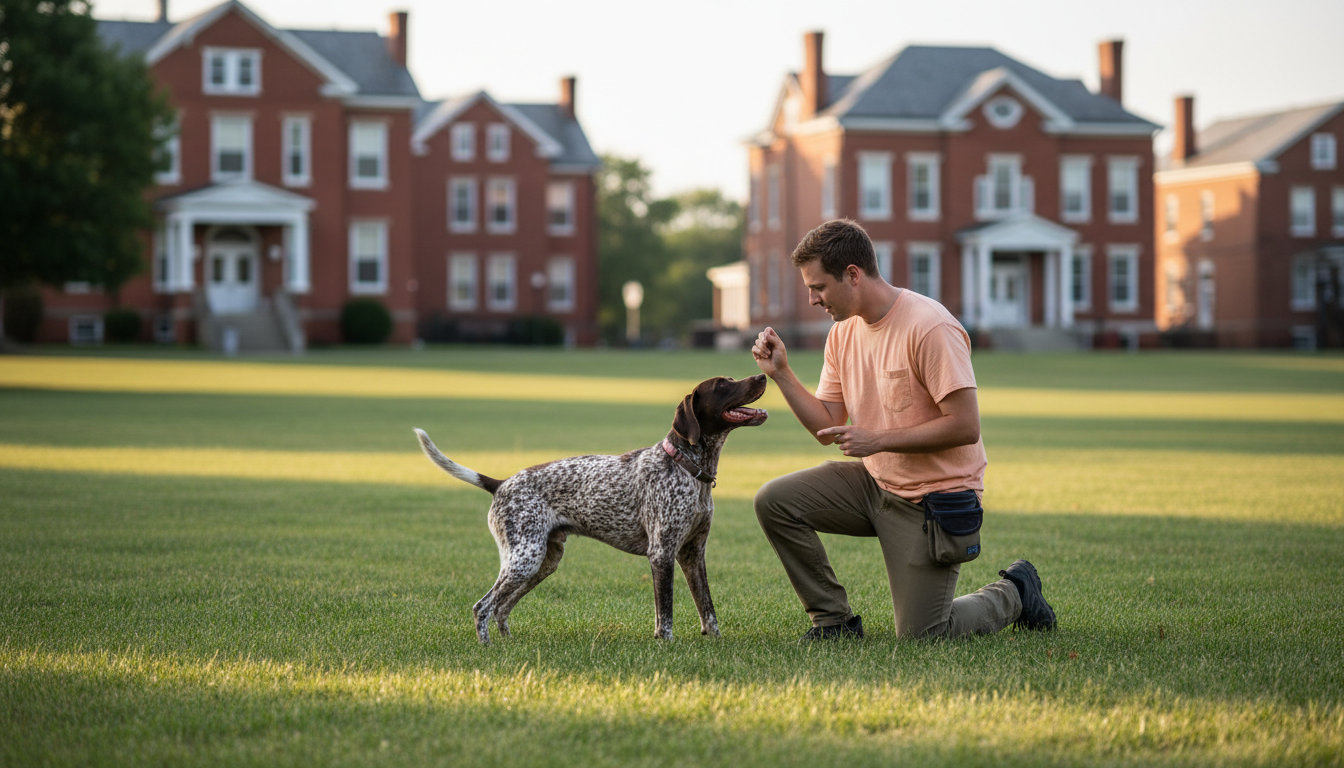
Reward-based methods build a strong, trusting relationship with your dog. They are the most effective way to create lasting good manners and ensure your dog remains under control, which is vital in a community with both residential and agricultural spaces.
Basic obedience covers sit, down, stay, recall, and loose-leash walking. These skills are the foundation for safe walks on rural roads and enjoyable visits to local trailheads.
Puppy training focuses on socialization to novel sights and sounds, potty training, bite inhibition, and crate training. Starting early prevents problems from becoming ingrained habits.
Behavior modification addresses issues like fear, reactivity, separation anxiety, or resource guarding through structured desensitization. For complex cases, a trainer should be willing to collaborate with your veterinarian.
Private lessons offer personalized attention for your specific goals. Day training can accelerate progress for busy owners, while well-managed group classes are ideal for practicing obedience around distractions.
Specialized training, like service dog training or therapy dog training, requires a trainer with experience in the specific legal and skill-based requirements for those roles.
Avoid any trainer who uses intimidation, fear, or physical corrections. These outdated methods can worsen behavioral problems, damage your bond with your dog, and are unnecessary for achieving a well-behaved dog.
Average Cost of dog training in Sabillasville, MD (Updated for 2026)
Pricing in the Sabillasville area and greater Frederick County is influenced by the trainer’s experience, travel distance, and the type of service. Here is a general overview of 2026 costs for professional dog training services in the region.
| Service Type | Average Cost (Frederick County Area) |
|---|---|
| Puppy classes (6 weeks) | $165–$300 total |
| Group obedience classes (6 weeks) | $180–$320 total |
| Private lessons (60 min) | $90–$160 per session |
| In-home training packages (4-6 sessions) | $400–$850 total |
| Day training (per week) | $400–$800 |
| Behavior consultation (initial) | $140–$225 |
| Board and train (2-3 weeks) | $1,800–$3,500 total |
Travel fees are common for in-home services in rural areas like Sabillasville. Always ask what is included in a package and what the policy is for follow-up support.
Questions to Ask a Potential Dog Trainer
- What is your primary training philosophy, and how do you ensure sessions are positive and stress-free?
- What professional credentials, like CPDT-KA or KPA-CTP, do you hold? Do you pursue continuing education such as CPDT-KSA?
- How will you tailor a training program for my dog’s needs and our semi-rural environment?
- Do you offer in-home dog training, group classes, or board and train, and what do you recommend for my goals?
- How do you measure progress and help transition skills from home to public settings?
- What are all the costs, including travel fees, and what is your cancellation policy?
- Do you carry professional liability insurance?
- For behavior issues, are you prepared to work with my veterinarian?
- What homework will I have between sessions to help my dog succeed?
Local Sabillasville Rules and Considerations
Frederick County enforces laws that promote responsible pet ownership and community safety. Understanding these helps you train for real-world compliance.
Dogs must be under the owner’s control at all times. While there is no universal county leash law, many public parks and all state parks require a leash not exceeding six feet. Control is legally required; a reliable recall is essential for off-leash activities on private property.
Maryland state law requires all dogs four months and older to be vaccinated against rabies. The rabies tag must be attached to the dog’s collar. Frederick County does not have a separate annual dog license requirement.
Excessive barking that disturbs neighbors can be considered a nuisance under county noise ordinances. Training for appropriate alert barking is important in close-knit rural communities.
Maryland does not require a specific state license to operate as a dog trainer. However, trainers running a business in Frederick County must have a general business license and are strongly advised to carry liability insurance. Trainers offering board and train services may be subject to Maryland's kennel regulations.
Local Sabillasville Resources for Dog Owners
These local spots provide excellent environments to practice training skills in controlled and natural settings.
- Community Parks in Thurmont: Thurmont Community Park requires leashes but offers open spaces for practicing leash skills and focus around mild distractions.
- Cunningham Falls State Park: Leashed dogs are welcome on most trails, providing a beautiful, stimulating environment for proofing obedience around hikers, water, and wildlife.
- Catoctin Mountain Park (National Park): Dogs on leashes are permitted on most trails, offering a fantastic setting for building duration and focus in a natural environment.
- Frederick County Animal Control: Provides information on local animal laws, lost pets, and low-cost microchipping and rabies vaccination clinics.
FAQs
How much does in-home dog training cost?
In the Sabillasville area, a single in-home session typically costs between $90 and $160. Multi-session packages often provide a better overall value for ongoing training programs.
Is in-home dog training worth it?
Yes, especially in a rural setting. It allows the trainer to address behaviors exactly where they happen, such as door darting, reactions to wildlife through a window, or manners for meeting guests on your property.
Can you pay someone to house train your dog?
Yes. Many trainers include potty training as a core part of puppy training programs. For adult dogs, behavior modification techniques can effectively resolve house-soiling issues.
What is the 3-3-3 rule for dog training?
It’s a guideline for adopted dogs: 3 days to decompress, 3 weeks to learn your routine, and 3 months to feel at home. A good trainer will design a plan that respects this adjustment period.
How long will it take to reach my training goals?
For basic obedience and manners, consistent practice over 6-8 weeks usually yields strong results. Behavior modification for fear or reactivity is a longer process, often taking several months of dedicated work.
What should I bring to group classes?
Bring a well-fitting collar or harness, a 4-6 foot leash, high-value treats, and your dog’s vaccination records. Avoid retractable leashes for the safety of all participants.
What’s the leash law in Sabillasville?
Sabillasville follows Frederick County regulations, which mandate that dogs be under control. While there’s no blanket leash law, leashes are required in all county and state parks. Effective verbal control is legally necessary for any off-leash activity.
Do I need a dog license in Sabillasville or county?
Frederick County does not issue general dog licenses. However, Maryland law requires a current rabies vaccination, and the rabies tag must be worn on your dog’s collar at all times.
What shots does my dog need in county or Maryland?
Rabies vaccination is mandatory by state law. Your veterinarian will also recommend a core vaccine schedule for distemper, parvovirus, and adenovirus, often based on your dog’s potential exposure in rural areas.
Are dog trainers required to be licensed in Sabillasville or county or Maryland?
Maryland does not have a specific professional license for dog trainers. They must operate with a standard Frederick County business license. Those offering boarding services must comply with state kennel regulations.
Where can I practice off-leash recall?
The safest place is a securely fenced area on private property. There are no public, fenced dog parks in immediate Sabillasville, so practicing in a controlled, enclosed space you have permission to use is essential.
Which dog parks allow training around Sabillasville?
The nearest public dog parks are in the Frederick city area, such as the Dog Park at Baker Park. These fenced facilities are suitable for practicing recalls and socialization during off-peak hours.
What beaches or trails allow dogs for training?
Leashed dogs are welcome on trails at Cunningham Falls State Park and Catoctin Mountain Park. These are excellent for practicing calm leash walking and focus amidst natural distractions.
Are there local ordinances about barking in rural areas?
Yes. Frederick County’s nuisance ordinance addresses animals that create “unreasonable noise” audible beyond the property line. Training to manage alert barking is important for maintaining good neighbor relations.