Your Complete Guide to Choosing a Dog Trainer in Chimacum and surrounding areas
Life with a dog in Chimacum means enjoying quiet country lanes, forested trails, and a close-knit community. Your dog needs to be a good neighbor, whether that means not chasing livestock, staying calm around wildlife, or walking politely on shared rural roads. Finding a local trainer who understands this unique setting is key to a happy life together.
As an unincorporated community in Jefferson County, local rules follow county and Washington State guidelines. A trainer familiar with this area can help you navigate everything from leash laws on the Olympic Discovery Trail to managing your dog’s behavior around the farms and forests that define our home.
How to Choose the Right Trainer
Look for a professional dog trainer who uses *positive reinforcement* training methods. This approach builds a trusting relationship with your dog, which is essential for reliability in our distraction-filled environment. Your dog should learn to ignore deer, respect livestock fencing, and remain calm during ferry line waits or visits to the Chimacum Corner Farmstand.
Credentials help verify a trainer’s knowledge. Look for professionals with certifications like the CPDT-KA or KPA-CTP. For serious behavioral concerns like reactivity or severe anxiety, a certification such as the IAABC-CDBC indicates specialized expertise.
In-home sessions are invaluable for addressing behaviors specific to your property, like barking at passing farm equipment or boundary training. Group classes provide controlled environments to practice manners around other dogs, a useful skill before heading to busier county parks.
Common Dog Training Methods Explained
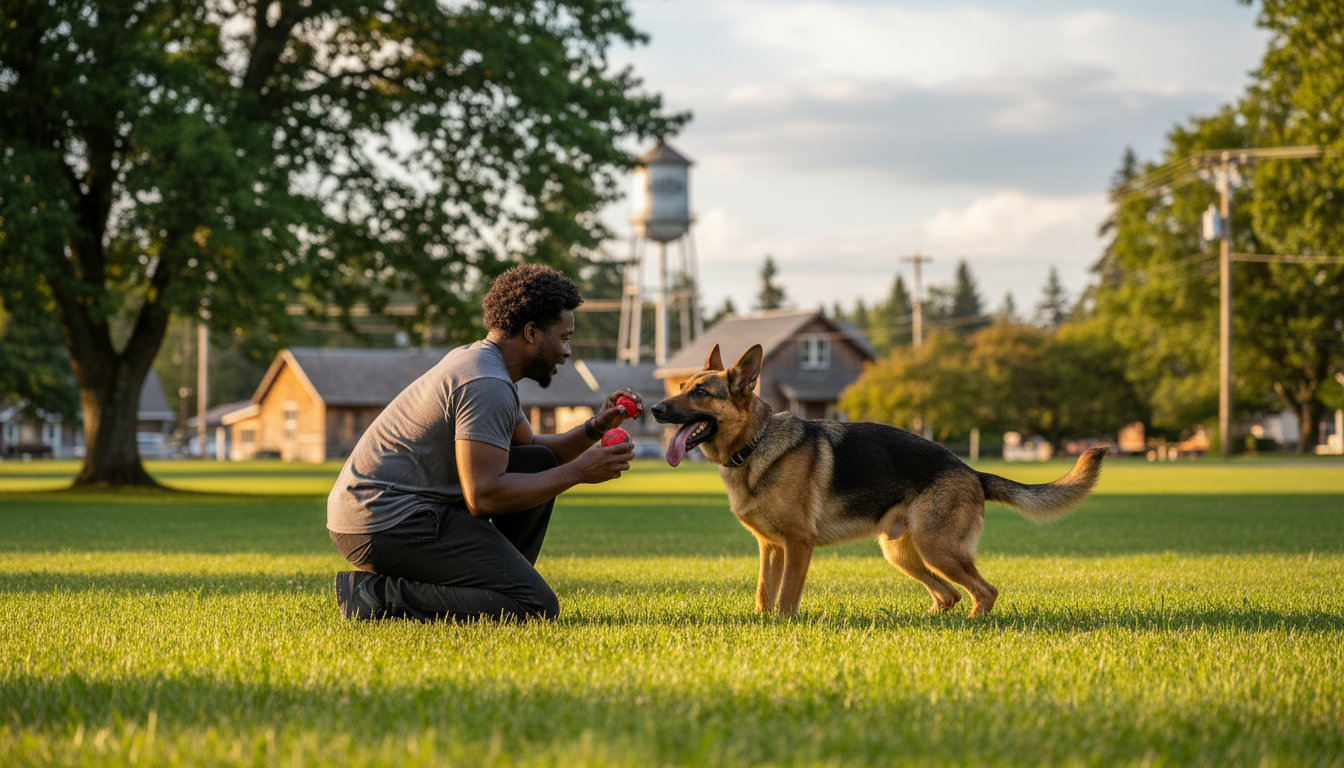
Humane, science-based methods are the most effective and ethical choice. They align with building a well-behaved dog that can adapt to the relaxed yet responsible ethos of Jefferson County.
Basic obedience training**** creates a foundation of communication. Skills like a reliable recall, loose-leash walking, and a solid “stay” are non-negotiable for safety in our open spaces.
Puppy training focuses on proper socialization, potty training, bite inhibition, and crate training. Early positive experiences set your puppy up for a confident life exploring the Peninsula.
Behavior modification addresses issues like fear, reactivity, separation anxiety, or resource guarding through structured desensitization. This work often requires close coordination with your veterinarian.
Private lessons offer tailored solutions for your specific goals and environment. Board and train programs can provide intensive immersion, but it’s crucial to ensure the trainer focuses on teaching you how to maintain the skills.
Group classes are excellent for proofing obedience around distractions in a safe, structured setting. Look for classes that manage excitement levels and teach calm focus.
Specialized training, such as therapy dog training or service dog training, requires a trainer with a proven, step-by-step curriculum for public access skills and task training.
Avoid any trainer who uses intimidation, fear, or pain as tools. These outdated methods can worsen behavioral problems, damage your bond with your dog, and are unnecessary for achieving lasting results.
Average Cost of dog training in Chimacum, WA (Updated for 2026)
Pricing in Jefferson County and the wider North Olympic Peninsula reflects a mix of local and traveling trainers. Costs are influenced by the trainer’s experience, travel distance, and the program’s intensity. The table below reflects 2026 averages for the Chimacum and East Jefferson County area.
| Service Type | Average Cost (Jefferson County Area) |
|---|---|
| Puppy Classes (6 weeks) | $165–$250 total |
| Group Obedience Classes (6 weeks) | $180–$300 total |
| Private Lessons (60 min) | $90–$150 per session |
| In-Home Training Packages (4-6 sessions) | $400–$850 total |
| Day Training (per week) | $450–$800 total |
| Behavior Consultation | $125–$200 initial |
| Board and Train (2 weeks) | $1,800–$3,500 total |
Travel fees are common for in-home sessions in rural areas like Chimacum. Always ask what is included in a quoted price and the trainer’s policy on follow-up support.
Questions to Ask a Potential Dog Trainer
- What is your primary training philosophy, and can you describe a typical session?
- What professional dog trainer certifications do you hold, and how do you pursue continuing education?
- What is your experience training dogs for rural and farm-adjacent environments like Chimacum?
- Do you offer in-home training, and how do you handle travel to more remote properties?
- How do you measure progress, and what does communication look like between sessions?
- Can you provide a clear breakdown of costs and your cancellation policy?
- Do you carry professional liability insurance?
- For behavior issues, are you willing to collaborate with my veterinarian?
Local Chimacum Rules and Considerations
Jefferson County enforces regulations to protect people, pets, and wildlife. Understanding these rules helps you train for real-world compliance.
Dogs must be under direct control at all times. While leash laws are specific to each municipality and park, the county requires that dogs not run at large. This means even on your own rural property, a dog must be contained or under voice control so as not to wander onto a neighbor’s land or road.
Washington State law mandates that all dogs be vaccinated against rabies by a licensed veterinarian. A rabies tag must be attached to the dog’s collar. Jefferson County Public Health provides information on low-cost clinic options.
Excessive barking that disturbs neighbors can be considered a nuisance. Training for alert barking and separation anxiety is a considerate step for peaceful country living.
Washington State does not require a specific license to be a dog trainer. However, any business operating in the state must have a general business license. Trainers offering board and train services must comply with Washington's commercial kennel regulations, which include licensing and inspections.
Professional dog trainers are strongly advised to carry general liability insurance. While not a county or state mandate, it is a standard business practice that protects both the trainer and the client.
Local Chimacum Resources for Dog Owners
These local spots provide excellent environments to practice training in real-world settings. Always adhere to posted rules and practice good etiquette.
- H.J. Carroll Park: This county park in Chimacum offers expansive fields and trails (leash required) perfect for practicing long-line recalls and leash skills in a controlled, scenic setting.
- Chimacum Creek Park: A quieter park with trails along the creek, ideal for working on focus around natural distractions like water and wildlife.
- Anderson Lake State Park: Located just south of Chimacum, this park allows leashed dogs on its trails, offering a beautiful, natural environment for proofing obedience.
- Fort Flagler State Park: A short drive north, this park has miles of leashed beach and trail access for advanced training around varied sights and sounds.
- Jefferson County Humane Society: A local resource for adoption, lost and found services, and community education.
FAQs
How much does in-home dog training cost?
In the Chimacum area, a single in-home session typically costs between $90 and $150. Most trainers offer package discounts, bringing the per-session rate down. Expect potential travel fees for very remote locations.
Is in-home dog training worth it?
Yes, particularly in a rural area. It allows the trainer to address behaviors exactly where they happen—whether it’s barking at the fence line, chasing chickens, or greeting guests at your specific driveway. Training can then generalize directly to your daily routines.
Can you pay someone to house train your dog?
Many trainers offer puppy programs that include a structured plan for potty training. Some day training services can also implement the schedule and reinforce the behavior, but the owner’s consistent follow-through is always essential for success.
What is the 3-3-3 rule for dog training?
This is a guideline for a newly adopted dog’s adjustment: 3 days to decompress, 3 weeks to learn your routines, and 3 months to feel fully at home. A good trainer will craft a plan that respects this timeline.
How long will it take to reach my training goals?
For basic obedience and manners, consistent practice over 6-8 weeks typically yields solid results. More complex behavior modification, like fear or reactivity, is a longer-term process often taking several months of dedicated work.
What should I bring to group classes?
Bring a well-fitting collar or harness, a 6-foot leash (no retractables), high-value treats, your dog’s vaccination records, and an eager-to-learn attitude.
What’s the leash law in Chimacum?
As an unincorporated community, Jefferson County’s “at large” ordinance applies. Dogs must be under control at all times. In all county and state parks, dogs must be on a leash no longer than 8 feet unless in a designated off-leash area.
Do I need a dog license in Chimacum or county?
Jefferson County does not require a general pet license. However, Washington State and county law require a current rabies vaccination, and the tag must be worn on your dog’s collar.
What shots does my dog need in county or WA?
Rabies vaccination is legally required. Your veterinarian will also recommend a core vaccine series (DAPP) and may suggest others like bordetella or leptospirosis based on your dog’s exposure risk in our environment.
Are dog trainers required to be licensed in Chimacum or county or WA?
Washington State does not have a specific license for dog trainers. They must operate as a legitimate business, which includes obtaining a state business license. Those offering boarding services must have a commercial kennel license.
Where can I practice off-leash recall?
The safest places are fully fenced private properties. Public off-leash areas are limited in East Jefferson County; the nearest designated dog park is in Sequim. Using a long-line (30-50 ft leash) in permitted areas like H.J. Carroll Park is a safe and legal alternative.
Which dog parks allow training around Chimacum?
There are no dedicated public dog parks in immediate Chimacum. For off-leash training, residents often use securely fenced private land. The fields at H.J. Carroll Park are excellent for on-leash and long-line training work.
What beaches or trails allow dogs for training?
Many state parks allow leashed dogs. Fort Flagler, Anderson Lake, and Dosewallips State Parks offer fantastic trail and beach environments for practicing obedience amidst real-world distractions. Always keep your dog on a leash as required.
The right dog trainer will help you build a partnership with your dog that thrives in the unique landscape of Chimacum. By focusing on positive, consistent communication, you can ensure your dog is not only well-behaved but also a confident and joyful companion for all your Jefferson County adventures.