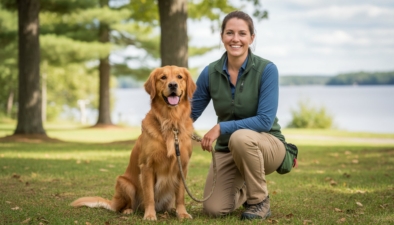
Your Complete Guide to Choosing a Dog Trainer in Hope and Surrounding Areas
Finding the right dog trainer in Hope means preparing your dog for a life that might include quiet walks through the Hatchet Mountain Preserve, visits to the general store, or outings to the bustling waterfronts of nearby Rockport and Camden. The skills your dog learns need to fit this unique mix of rural serenity and popular coastal destinations.
As a town within Knox County, Hope generally follows Maine state laws and county guidelines for pet ownership. A trainer familiar with this area understands how to help your dog stay calm around wildlife on local trails and be polite in more crowded public spaces.
How to Choose the Right Trainer
Look for a professional dog trainer who uses *positive reinforcement* training methods and can create realistic goals for life in Midcoast Maine. This means your dog should learn to walk calmly on a leash past grazing livestock, ignore distractions at a farm stand, and be comfortable riding in the car for trips to the vet or the coast.
Checking a trainer’s credentials is a smart way to gauge their education and commitment. Recognized dog trainer certifications like the CPDT-KA or KPA-CTP show a foundation in science-based methods. For serious behavior issues like fear or aggression, look for advanced credentials such as an IAABC-CDBC.
In-home dog training sessions are excellent for addressing specific issues like door-dashing, counter-surfing, or reactivity seen from your property. Group classes, often held in larger towns nearby, provide vital practice for learning to focus around other dogs and people.
Common Dog Training Methods Explained
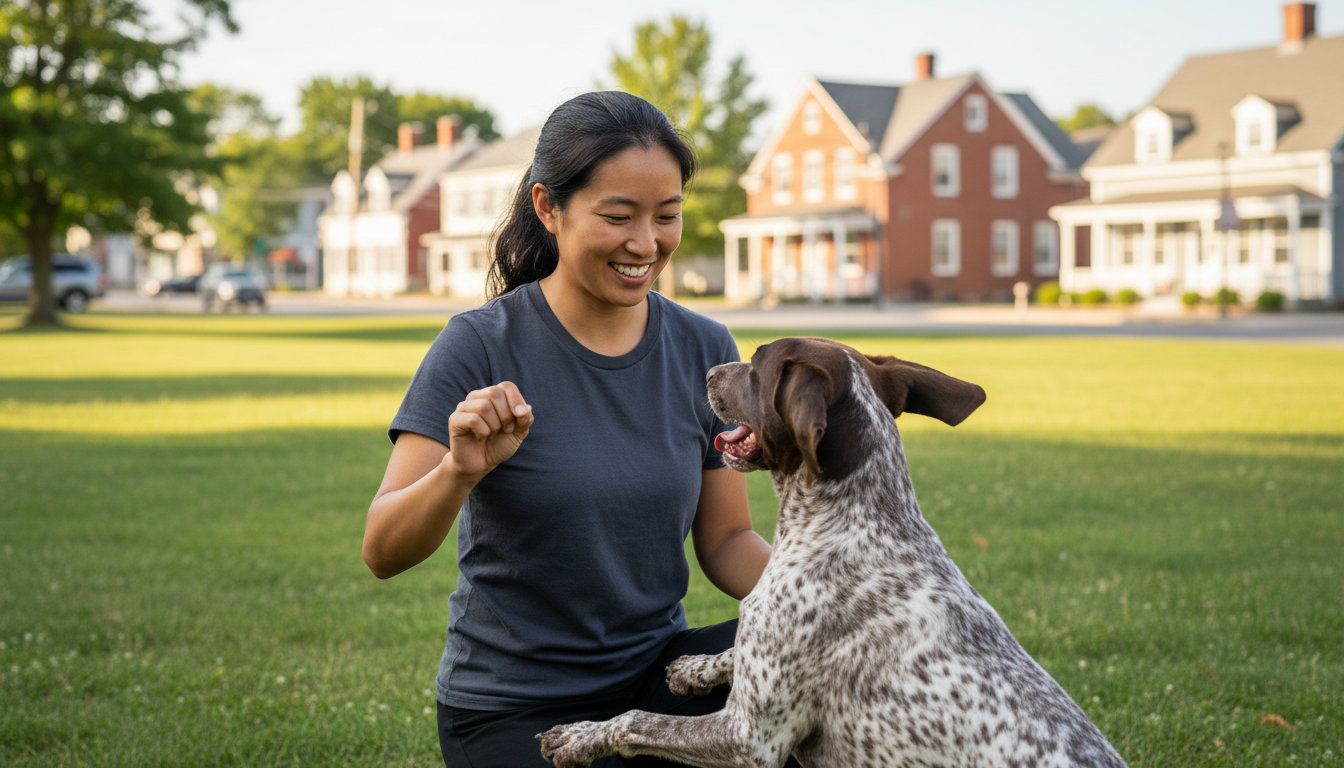
Modern, reward-based training builds a strong bond and encourages your dog to make good choices willingly. This approach aligns well with Maine’s expectations for responsible dog ownership and control.
Basic obedience training**** covers essential skills like sit, down, stay, recall, and loose-leash walking. These are the foundation for safely enjoying Knox County’s many trails and public spaces.
Puppy training focuses on early socialization, bite inhibition, potty training, and crate acclimation. Starting early helps prevent common problems and sets your puppy up for success in Hope’s quiet environment.
Behavior modification is a specialized process for dogs struggling with fear, reactivity, separation anxiety, or resource guarding. It involves slow, careful work to change your dog’s emotional response to triggers.
Private lessons offer one-on-one attention for tailored goals. Board and train programs, where the trainer works with your dog intensively, can be an option but require thorough vetting of the facility and methods.
Group classes are valuable for proofing skills around distractions in a controlled setting. Look for classes that manage the environment carefully to keep all dogs successful.
Always avoid trainers who rely on intimidation, fear, or pain to suppress behavior. Humane methods are safer, more effective for long-term learning, and help maintain good relationships with your neighbors in a close-knit community like Hope.
Average Cost of Dog Training in Hope, ME (Updated for 2026)
Pricing in Hope and the broader Knox County area is influenced by the trainer’s experience, travel distance, and the type of service. Many local trainers service the wider Midcoast region. Here is a regional average based on services in Hope and neighboring towns.
| Service Type | Average Cost (Knox County Region) |
|---|---|
| Puppy Class (6-week series) | $160 – $220 total |
| Group Obedience Class (6-week series) | $180 – $260 total |
| Private Lesson (60 min) | $90 – $140 per session |
| In-Home Training Package (4-6 sessions) | $400 – $750 total |
| Day Training (per week) | $400 – $800 |
| Behavior Consultation | $125 – $200 initial session |
| Board and Train (2 weeks) | $1,800 – $3,200 total |
Travel fees may apply for in-home services in more remote parts of Knox County. Always clarify what is included in the price and the trainer’s policy for progress guarantees or follow-up support.
Questions to Ask a Potential Dog Trainer
- What is your primary training philosophy, and can you explain how you use positive reinforcement?
- What professional certifications, like a CPDT-KA, do you hold? How do you pursue continuing education, such as the CPDT-KSA?
- Can you design a training program that considers my dog’s personality and our lifestyle in a rural area?
- What services do you offer (in-home, group classes, etc.), and which do you recommend for my goals?
- How will we track my dog’s progress, and what does “homework” between sessions look like?
- Can you provide proof of liability insurance?
- Do you collaborate with veterinarians for cases involving anxiety or aggression?
- What are your total fees, cancellation policy, and any travel charges for Hope?
Local Hope Rules and Considerations
Hope does not have its own municipal animal control ordinance, so state laws and Knox County provisions apply. Understanding these helps ensure your training supports legal compliance.
Maine state law requires dogs to be under “direct control” of their owner in public, which is typically interpreted as leash control. A reliable recall is essential, but a leash is the safest and most legally sound tool for public areas.
Maine mandates a rabies vaccination for all dogs. The rabies tag must be attached to your dog’s collar. Proof of vaccination is required for licensing.
Excessive barking that disturbs neighbors can be considered a nuisance under Maine law. Training can help manage alert barking, which is especially useful in quiet, rural settings.
The State of Maine does not require a specific license to operate as a dog trainer. However, trainers should carry general business liability insurance. If a trainer offers boarding as part of a board and train service, their facility may need to comply with state kennel licensing regulations.
Local Hope Resources for Dog Owners
These local spots provide excellent environments to practice training in real-world settings. Always follow posted rules and practice good etiquette.
- Hope Town Office: The primary local resource for town-specific information and dog licensing.
- Hatchet Mountain Preserve: Offers trails for practicing structured walks and leash skills in a natural setting. Dogs must be leashed.
- Hosmer Pond: A popular local spot for swimming and walks; a great place to practice recalls on a long line in a less confined area, always with consideration for others.
- Coastal Trails Nearby: For more distraction-proofing, leashed dogs are welcome on many trails in Camden Hills State Park and the Ducktrap Preserve in Lincolnville.
FAQs
How much does in-home dog training cost?
In the Hope area, a single in-home session typically costs between $90 and $140. Most trainers offer discounted packages for multiple sessions, which is common for addressing behavior problems.
Is in-home dog training worth it?
Yes, particularly in a rural area. An in-home trainer can address behaviors exactly where they happen—like chasing wildlife in your yard, reacting to delivery trucks on your quiet road, or jumping on guests at your front door.
Can you pay someone to house train your dog?
Many trainers offer puppy programs that include house training plans. Some day training services can also accelerate the process by implementing a consistent schedule during the day and teaching you how to maintain it.
What is the 3-3-3 rule for dog training?
This is a guideline for adopted dogs. It suggests 3 days to decompress, 3 weeks to learn routines, and 3 months to feel at home. A good trainer will work with this adjustment period.
How long will it take to reach my training goals?
For basic manners, you often see significant improvement in 4-8 weeks with consistent practice. More complex behavior modification for fear or reactivity usually requires a commitment of several months.
What should I bring to group classes?
Bring a standard 6-foot leash, a well-fitting collar or harness, high-value treats, and your dog’s vaccination records if required by the training facility. Avoid retractable leashes.
What’s the leash law in Hope?
Hope defers to Maine state law, which requires dogs to be under “direct control.” This effectively means your dog should be leashed in all public spaces unless on your own property. A strong recall is vital for safety but does not replace leash laws.
Do I need a dog license in Hope or Knox County?
Yes. All dogs in Maine must be licensed annually in the town where they reside. You can license your dog at the Hope Town Office with proof of a current rabies vaccination.
What shots does my dog need in Knox County or Maine?
Rabies vaccination is legally required. Your veterinarian will also recommend a core vaccine series (like DAPP) and may suggest others like bordetella or leptospirosis based on your dog’s exposure risk in rural Maine.
Are dog trainers required to be licensed in Hope or Maine?
No, Maine does not have a specific state license for dog trainers. They operate under standard business regulations. Always ask for proof of liability insurance.
Where can I practice off-leash recall?
The safest places are fully fenced areas. Public off-leash areas are limited in immediate Hope, but fenced dog parks exist in nearby towns like Rockland and Camden. Using a long line on private property or in isolated areas is a good training step.
Which dog parks allow training around Hope?
While Hope does not have a public dog park, the Rockland Dog Park and Camden Dog Park are the closest fenced facilities. These are suitable for practicing supervised play and off-leash recalls in a controlled environment.
What beaches or trails allow dogs for training?
Leashed dogs are permitted on most trails in Camden Hills State Park, providing excellent training grounds with varying distractions. Always check current rules for specific beach areas, as seasonal restrictions often apply to protect wildlife.